Digital Twin for Schools: Preventive Maintenance in Your Educational Institution
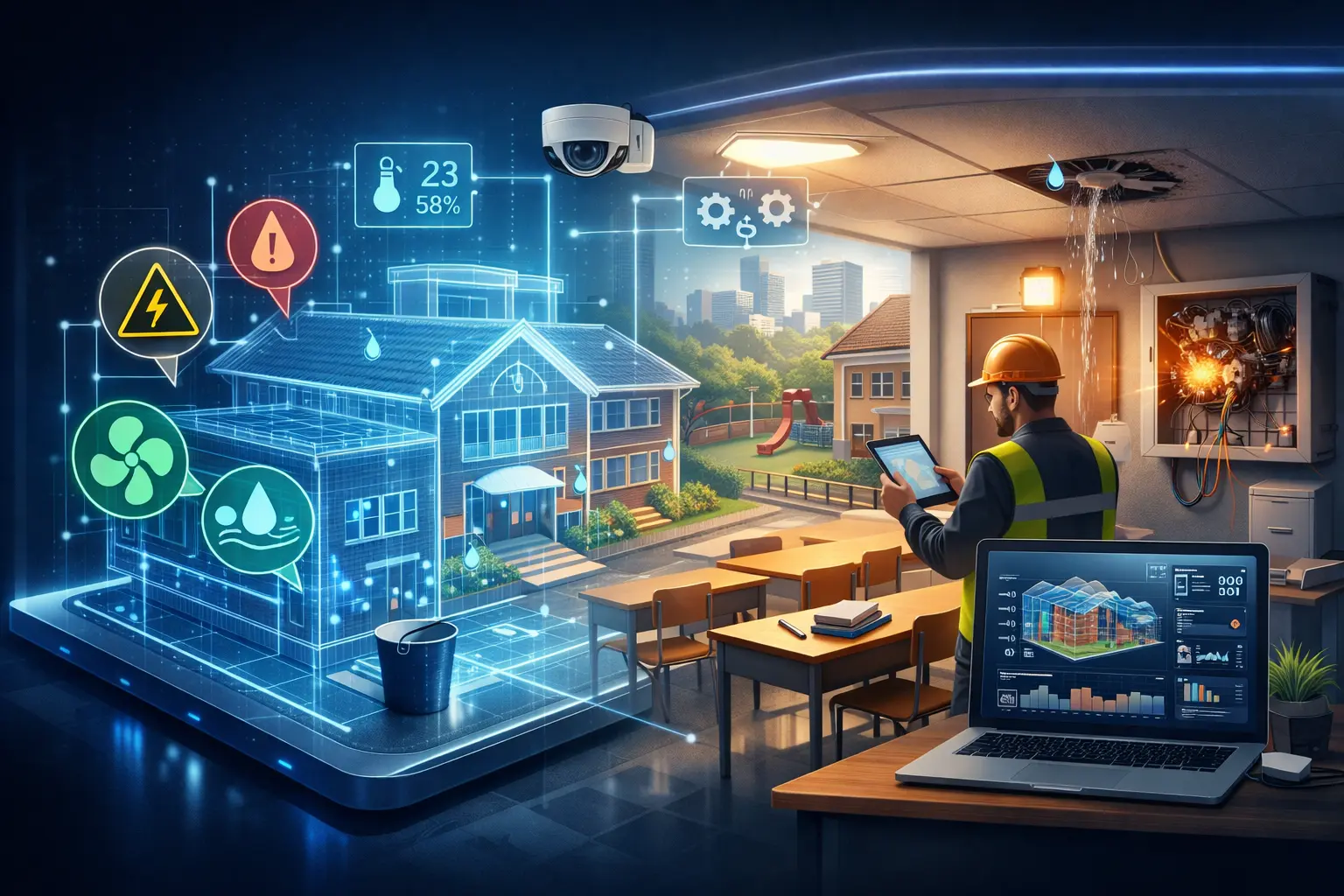
Imagine that there are only six months left until the 2026 school return and you discover that three classrooms have leaks, the electrical system of a building needs urgent updating, and you have no clear record of the real state of your infrastructure. This situation repeats every school cycle in hundreds of campuses because traditional school maintenance management relies on manual inspections, paper reports, and reactive decisions that always come too late.
Now there is a completely different way to manage your educational facilities: digital twins.. This technology, which combines BIM educational infrastructure with real-time data, allows you to visualize every corner of your school in an interactive 3D model, anticipate problems before they become emergencies, and plan school campus maintenance months in advance.
At FOUNDTECH hemos visto cómo directores y administradores educativos podrían transformar la gestión de sus espacios con gemelos digitales para escuelas, pasando del caos preventivo a la tranquilidad operativa. In this article, you will discover exactly how this technology can prepare your institution for 2026 and the years to come.
What Is a Digital Twin for Schools and Why Do You Need It Now?
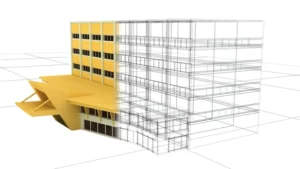
A school digital twin is an exact virtual replica of your educational infrastructure that integrates:
- A high-precision 3D BIM model of all your buildings, classrooms, laboratories, and common areas.
- Real-time data from MEP systems (mechanical, electrical, and plumbing)
- IoT sensors that monitor temperature, humidity, energy consumption, and occupancy.
- A digitized maintenance history accessible from any device.
- Predictive simulations that anticipate failures before they occur.
The Difference Between Traditional Management and Digital Twin Management
|
Aspect |
Traditional Management |
Educational Digital Twin |
|
Inspections |
Manuals, every 6-12 months |
Continuous 24/7 monitoring with sensors and digital indicators |
|
Documentation |
Paper blueprints, scattered files |
Unified 3D model with up-to-date data and full traceability. |
|
Problem detection |
Reactive (when visible damage has already appeared) |
Predictive (alerts before failure thanks to analytics). |
|
Maintenance planning |
Based on a fixed schedule |
Based on actual equipment condition and usage patterns. |
|
Response time |
Days or weeks |
Minutes or hours with automated alerts. |
|
Repair cost |
High (corrective maintenance) |
Reduced by applying predictive and planned maintenance. |
Why Is 2026 the Key Moment?
In Mexico, a significant portion of the educational infrastructure is decades old, which increases the risk of critical failures in electrical, hydraulic, and safety systems. By the 2026 back-to-school season, institutions that have not digitized their management will face:
- Greater competition from schools that already offer modern, connected facilities.
- Rising costs of corrective maintenance and unplanned shutdowns.
- Regulatory pressure and stricter audits on safety and facilities.
- Higher expectations from parents and students regarding sustainability and technology.
Learn how Scan-to-BIM is transforming infrastructure in Mexico
.
How the Digital Twin Works in School Facility Maintenance
Implementing a digital twin in your educational institution follows a structured four-phase process that guarantees accuracy and measurable results from day one.
Phase 1: Data Capture with 3D Laser Technology
The process begins with a 3D scan of your entire educational infrastructure to generate a detailed point cloud This capture makes it possible to document geometry, heights, visible installations, and real conditions without relying on outdated plans.
In a typical campus, the survey can be carried out in a few days, including exteriors, roofs, and hard-to-access areas, taking advantage of times without classes to avoid disrupting activities.
Phase 2: BIM Modeling of Educational Infrastructure
The captured data is converted into a BIM (Building Information Modeling) model that integrates architecture, structure, and installations in a single digital environment. Each element in the model can be associated with key information such as technical data sheets, service life, maintenance performed, and manufacturer recommendations
This model becomes the foundation of the digital twin, on which sensors, maintenance management systems, and control dashboards are connected.
Phase 3: Integration of IoT Sensors and Real-Time Data
The digital twin comes to life when it is connected to real-time data from sensors and measuring instruments distributed throughout the campus. Variables such as temperature, humidity, energy consumption, flow rates, and occupancy feed the model and allow deviations from expected behavior to be detected.
With this historical record, it is possible to identify patterns, peak-load times, and areas with abnormal performance, thus prioritizing interventions.
Phase 4: Predictive Analysis and Automated Alerts
Advanced analytics and digital simulation make it possible to anticipate failures, optimize maintenance schedules, and reduce unplanned shutdowns. The system can generate alerts when a piece of equipment consumes more energy than normal, overheats, or exceeds thresholds defined by the manufacturer.
This approach turns maintenance into a proactive process, with decisions based on data rather than perceptions or last-minute emergencies.
Discover more about predictive maintenance with simulation and digital twins
.Concrete Benefits of the Digital Twin in Educational Institutions
Reduction of Operational Costs
The predictive maintenance based on digital twins
It helps reduce serious failures and downtime, thus lowering operating costs.
By intervening only when the data indicates it, unnecessary maintenance is avoided and the useful life of assets is extended.
Furthermore, monitoring energy consumption allows for the identification of inefficiencies and the adjustment of settings to save energy without sacrificing comfort.
Security and Regulatory Compliance
Having an updated digital model makes it easier to demonstrate the status of electrical installations, evacuation routes, fire-fighting equipment, and critical systems during audits.
The traceability of interventions and safety tests is recorded, which simplifies regulatory compliance and reduces the risk of penalties.
Full visibility of the infrastructure also helps to plan structural and civil protection improvements with less improvisation.
Strategic Planning with Real Data
Managers can use the digital twin to answer key questions such as: actual classroom capacity, available electrical load reserves, or areas with higher wear and tear.
This information makes it possible to prioritize investments, decide where to expand, remodel or reinforce, and justify budgets to boards and trustees.
Simulations allow for the evaluation of different enrollment growth scenarios without compromising safety or comfort.
Enhanced Experience for Students and Staff
A facility with well-calibrated systems offers better temperature, lighting, and air quality conditions, which impacts concentration, health, and well-being.
Fewer failures in air conditioning, lighting, and basic services translate into fewer class interruptions and a more professional perception of the institution.
This positive experience strengthens the school’s reputation and becomes a differentiator compared to other schools.
Learn how digital twins are transforming other sectors such as healthcare.
Step-by-Step Implementation: From Decision to Results in 90 Days
Week 1-2: Diagnosis and Planning
- Meeting with management and maintenance to map risks, priority buildings and systems.
- Review of existing plans, maintenance contracts, and historical failure records.
- Definition of objectives, scope, KPIs and budget for the digital twin project.
Weeks 3-5: Data Capture (3D Scanning)
- Planning lifting days during school breaks or holiday periods.
- Scanning of exteriors, interiors, technical rooms and critical areas to generate the point cloud.
- Validation of the captured information and organization of reference photographic material.
Weeks 6-9: BIM Modeling and Digital Twin Configuration
- Point cloud processing and creation of the BIM model with architecture, structure and MEP.
- Loading relevant metadata and configuring the control panel and views for maintenance.
- Progressive integration of existing IoT sensors or recommendation for gradual deployment.
Week 10-12: Training and Start-up
- Sessions for managers focused on interpreting indicators, prioritizing and justifying investments.
- Training for the maintenance team on daily use of the system, work orders, and data updates.
- Fine-tuned alert configuration, periodic reports, and close support during the first few months.
Month 4 Onwards: Continuous Optimization and Scaling
From the fourth month onward, the focus shifts from implementation to continuous optimization, using accumulated data to adjust maintenance strategies, update alert thresholds, and improve resource allocation each school year. With the experience gained from the first digitized buildings, your institution can scale the digital twin to other campuses, consolidating a network of schools that are safer, more efficient, and better prepared for the future.
If your educational institution is looking to reduce costs, improve safety, and make data-driven decisions, you can start your digital transformation with FOUNDTECH’s 3D scanning, BIM, and digital twin services in Mexico.