Fourth Industrial Revolution: How It Changed the Manufacturing Landscape
In summary: the Fourth Industrial Revolution integrated IoT, artificial intelligence, and Big Data into industrial processes, giving rise to smart factories, digital twins, and more flexible, personalized manufacturing. This article explains what exactly changed in the manufacturing landscape, which sectors benefited most, and how Foundtech applies these same principles on real projects.
The Fourth Industrial Revolution, or Industry 4.0, has arrived to revolutionize the manufacturing sector by integrating advanced technologies that are transforming the way companies design, manufacture, and distribute their products. With the emergence of the Internet of Things (IoT), Artificial Intelligence (AI), and Big Data, the Fourth Industrial Revolution is driving a new era of digital twins, smart factories, and automated processes. But what exactly is Industry 4.0, and how has it changed the manufacturing landscape?
What is the Fourth Industrial Revolution?
The Fourth Industrial Revolution refers to the integration of intelligent digital technologies into industrial processes. How does it happen? We explain it in this video:
This revolution not only optimizes production but also facilitates data-driven decision-making in real time. Here are some of its key features:
- Integrated technologies: Industry 4.0 connects technologies such as IoT, AI, Big Data, and robotics to create a smarter and more efficient production environment.
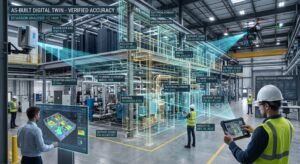
- Smart factories: factories of the future are capable of self-optimization, with automated processes that quickly respond to market demands.
- Enhanced productivity: the combination of technology and data optimizes efficiency, reducing costs and improving product quality.
- Smart decisions: real-time data collection and analysis enable companies to make more informed and agile decisions.
- Human-machine collaboration: Industry 4.0 promotes collaboration between workers and machines, increasing flexibility and customization in production.
How Is It Changing Manufacturing?
The arrival of Industry 4.0 has redefined the manufacturing landscape, causing significant changes in various aspects:
- Technological advances: with automation, AI, and IoT, factories operate more efficiently and flexibly, collecting and analyzing real-time data to optimize production processes.
- Reconfiguration of value chains: globalization and geopolitical tensions have led to the reconfiguration of supply chains, now focusing on resilience and diversification of sources.
- Shift in consumer demand: consumers are demanding personalized and sustainable products. In response, companies are adopting more flexible and eco-friendly production processes.
- Shortage of skilled labor: automation has created a demand for specialized workers, presenting a challenge for the industry.
- Focus on sustainability: sustainability has become imperative, with an emphasis on reducing carbon footprints and adopting more eco-friendly practices.
You might also like: Impact of Industry 4.0 on Productivity: Case Studies
Industries Most Benefited by Industry 4.0
Industry 4.0 has impacted multiple industrial sectors, enhancing efficiency and allowing for greater product customization.
| Sector | How it benefits |
|---|---|
| Automotive | Collaborative robotics and computer vision optimize production and improve quality |
| Agrifood | Drones and computer vision enable more precise control in agricultural production |
| General manufacturing | Real-time data analysis reduces costs and improves quality |
| Healthcare | Medical device manufacturing and patient data management are transformed |
| Logistics | IoT optimizes inventory management and routing across the supply chain |
| Electronics | Simulation and virtual testing reduce development time |
Impact of Industry 4.0 on Product Quality and Customization
Industry 4.0 has enabled companies to improve the quality and customization of their products, resulting in a competitive advantage in the market.
- Improvement in quality: the integration of advanced technologies such as AI and IoT allows for real-time monitoring and control of production processes, reducing errors and enhancing final quality.
- Increased customization: production lines can now be quickly adjusted to offer personalized products at scale, aligning with the expectations of the modern consumer.
How Foundtech Applies These Same Principles
One of the pillars of the Fourth Industrial Revolution, having reliable digital data about the real condition of assets, is exactly what Foundtech generated for the Werdhölzli wastewater treatment plant in Switzerland. The digital twin created from 3D laser scanning served as a verifiable data foundation for planning the plant’s redesign based on real site conditions, instead of outdated documentation. See more of Foundtech’s real projects.
Frequently Asked Questions About the Fourth Industrial Revolution
What advances did the Fourth Industrial Revolution bring?
Its main advances are connecting machines and systems through IoT, advanced automation with artificial intelligence, Big Data analysis for real-time decision-making, and digital twins, which let you simulate and monitor physical processes from a digital model.
What is the impact of the Fourth Industrial Revolution on companies?
It reduces operating costs, improves product quality, enables larger-scale customization, and supports faster decisions based on real process data instead of estimates.
The Fourth Industrial Revolution has transformed manufacturing by integrating advanced technologies that enhance efficiency, quality, and product customization. As more sectors adopt these innovations, new opportunities and business models emerge. In this new landscape, companies that adopt these technologies will not only meet market demands but exceed consumer expectations, ensuring their competitiveness in the future.