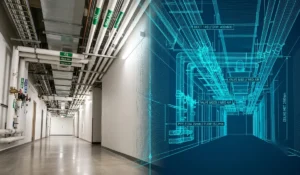
Optimize Your Supply Chain with Digital Twins
Digital twins in logistics are the most effective way to move from a reactive operation to a truly optimized supply chain: they let you simulate, measure and adjust your entire logistics ecosystem in real time to reduce costs, increase capacity and gain resilience.
If you are looking to optimize your logistics operation, reduce times and costs in warehouses, routes and last mile, digital twins have become the key tool to achieve it. By creating an accurate virtual replica of distribution centers, transport networks and inventory flows, it is possible to simulate scenarios, detect bottlenecks and make data-based decisions, not assumptions. Companies that adopt digital twins in their supply chain have reported major improvements in operational efficiency and reductions in logistics costs, consolidating them as one of the pillars of Logistics 4.0.
At Foundtech, we combine 3D laser scanning, BIM and IoT integration to build these models with millimeter precision, allowing operational optimization in logistics to go from an aspirational goal to a measurable reality.
Operational optimization with digital twins: from reactive to predictive
Modern logistics operates in an environment of frequent disruptions, unpredictable demand peaks and constant pressure on margins. The difference between reacting to problems once they have already hit the operation and anticipating them with digital twins can determine millions in losses or savings.
The concept of Logistics 4.0 incorporates technologies such as IoT, advanced analytics and digital twins to create connected virtual replicas of warehouses, networks and fleets. These replicas make it possible to simulate processes, evaluate decisions before executing them and adjust the operation in real time, something Foundtech can develop specifically for logistics environments through 3D capture, BIM and data platforms.
Recent studies on the adoption of digital twins in the supply chain report significant impacts: some organizations have achieved operational efficiency improvements close to 25–30% and notable reductions in logistics costs by optimizing routing, inventory levels and resource use.*
What are digital twins in the supply chain?
A logistics digital twin is a dynamic virtual representation of your physical network: warehouses, distribution centers, transport systems, inventories, equipment and operational flows, continuously fed by data from WMS/ERP systems, IoT sensors and fleet telematics. Unlike a simple 3D model, the digital twin:
- Updates in near real time.
- Integrates operational and business data.
- Makes it possible to simulate and optimize complete logistics processes.sciencedirect+1
1. Digitized physical layer (Scan-to-BIM)
The foundation is a precise survey of the facilities using 3D laser scanning, which generates point clouds and 3D As-Built models with millimeter precision. That geometry is transformed into a BIM model where racks, aisles, loading docks and structural elements are defined with relevant attributes (capacities, constraints, technical information).
- Integration of operational data in real time
The BIM model connects with:
- WMS/ERP: inventories, locations, orders, SLAs.
- IoT sensors: temperature, humidity, occupancy, equipment status.
- Internal automation: conveyors, sorters, AGVs, robots.
- Fleets: GPS, transit times, fuel consumption.
- Energy systems: HVAC, lighting and refrigeration consumption.
This fabric of data turns the digital twin into an operational “control tower” that reflects the current state of the logistics network.
3. Simulation engine and predictive analytics
On top of this foundation, simulation and analytics algorithms:
- Model layout changes and workflows.
- Predict demand and capacity needs.
- Optimize slotting, picking routes and transport routing.
- Identify bottlenecks before they show up in the metrics.
4. Visualization and control interface
Dashboards and interactive 3D views allow managers to see the state of the operation, receive alerts, test scenarios and execute decisions directly on the digital twin.
Digital twin vs. traditional 3D model
| Aspect | Traditional 3D model | Logistics digital twin |
| Updating | Manual and sporadic | Continuous, connected to operational data |
| Operational data | Not integrated | WMS, IoT, fleets, energy, etc. |
| Analysis capabilities | Static visualization | Simulation, optimization, predictive analytics |
| Interaction | View, measure | View, simulate, decide and feed back into the operation |
| Value for the business | Documentation | Efficiency, resilience and cost reduction |
Key applications of digital twins in Logistics 4.0
1. Warehouse layout and flow optimization
Inefficient warehouse designs create long routes, congestion and high preparation times. A digital twin makes it possible to test slotting and layout configurations in the virtual environment before making physical changes.
With simulations it is possible to:
- Place high-rotation SKUs near dispatch areas.
- Group complementary products.
- Evaluate aisle widths, staging areas, route lengths.
- Measure the impact on distance traveled, picking times and space utilization.
The Foundtech article on digital twins in logistics explains how these simulations make it possible to redesign warehouses with precision, reducing investment risk and accelerating the return.
2. Predictive maintenance of logistics equipment
Conveyors, sorters, automated storage systems and AGVs are critical to operational continuity. Digital twins, combined with sensors and analytics, make it possible to move to predictive maintenance, identifying likely failures before they occur.
In practice:
- Sensors measure vibration, temperature, cycles and consumption.
- The digital twin correlates that data with the operational context.
- Predictive models estimate likely failure windows and recommend interventions.
- Simulation evaluates how to reconfigure flows while a piece of equipment is under maintenance.
3. Supply chain simulation and resilience
Supply chain digital twins make it possible to simulate disruptions and design mitigation strategies before they occur. Research on digital twins in supply chains shows that their adoption improves visibility, speeds up decision-making and strengthens the ability to respond to unexpected events.
With a logistics network digital twin, you can:
- Simulate the failure of a supplier or distribution center.
- Evaluate alternative routes and backup centers.
- Adjust safety inventory levels by node.
- Run “stress tests” of your network against demand peaks or route closures.
4. Last-mile optimization and dynamic routing
The last mile is one of the most expensive components of logistics, and industry studies show that it can represent a very significant portion of total shipping costs, especially in dense B2C networks. Digital twins applied to the last mile make it possible to:
- Perform dynamic routing that adjusts to traffic, incidents and new orders.
- Simulate alternatives such as micro-fulfillment, pickup points and different delivery windows.
- Evaluate the introduction of electric vehicles considering range and charging points
Conclusion: why your logistics operation needs a digital twin
Logistics digital twins have stopped being an innovation experiment to become a strategic component of operational optimization in logistics, allowing distribution centers, fleets and entire networks to move from being managed by reaction to operating on simulations, predictions and integrated data. The evidence in supply chain shows clear improvements in efficiency, costs and resilience when precise 3D captures, BIM, IoT and advanced analytics are combined in a single operational model.
Relying on specialists like Foundtech, who master Scan-to-BIM, As-Built models, digital twins and predictive maintenance, allows you to build that digital foundation with millimeter precision and scale toward a measurable and profitable Logistics 4.0. In an environment where margins are increasingly tight and disruptions more frequent, investing in a digital twin is not just a technological upgrade: it is a strategic decision to protect and strengthen your supply chain.