5 signs your BIM model isn’t ready to power a digital twin
A BIM model is ready to power a digital twin when three things are true at once: its geometry comes from measurement on site rather than inherited drawings, every relevant asset carries information and not just shape, and someone owns keeping it current. Miss any one of the three and the twin does not fix the gap. It inherits it, then repeats it in every operating decision you make.
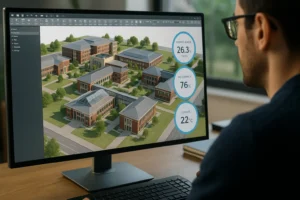
The gap between a BIM model and a digital twin is not a software gap, it is a data gap. BIM describes the building or the plant. A digital twin describes it and connects it to what is happening in the operation right now, through technical data and, where it makes sense, IoT sensors. That is why the twin inherits the quality of whatever sits underneath it: wrong geometry just produces wrong simulations faster. NIST research on inadequate interoperability put the cost to the U.S. capital facilities industry at $15.8 billion a year, with two thirds of it absorbed by owners and operators during operations and maintenance, which is exactly where a digital twin lives. At Foundtech we report that starting from reality captured with 3D scanning prevents up to 35% of the rework caused by outdated information.
8-minute read. By the end you will be able to diagnose your own model with five concrete questions, and know which of the five failures is blocking your digital twin project before you sign for it.
The conversation usually starts backwards. A plant manager sees a digital twin demo, likes the dashboard, and asks for pricing on the platform and the sensors. Nobody asks about the model underneath, because the model already exists: it is on the server, the contractor handed it over at closeout, and it carries the project name. Six weeks later the team finds out that file cannot serve as a foundation, and a good share of the budget went into finding that out.
At Foundtech we capture built reality with terrestrial laser scanners, accurate to ±2 mm to 10 mm depending on the equipment and site conditions, and we model to the standard of our alliance with the Swiss firm BIM Facility AG, executed by a local team. We have delivered more than 200 projects across Europe and the Americas, modeled over 10 million m², and hold ISO 19650 certification. At the Werdhölzli wastewater treatment plant in Switzerland we scanned the facility and modeled piping, tanks and structures from the point cloud. The modernization was designed and executed on that model, and the digital twin stayed available afterward for maintenance, logistics and asset management. That is why we do not audit a model in the abstract. We check it against the physical asset. These are the five signs we run into most often when a BIM model cannot yet carry a digital twin.
Sign 1: the model came from drawings, not from measurement
The first question to ask any model is where its geometry came from. If it was modeled from the construction documents, the bid CAD, or as-built drawings nobody verified on site, then it documents construction intent, not construction. In a plant with twenty years of modifications behind it, those two things parted ways a long time ago.
The symptom is easy to spot. The model looks flawless, everything square and level, because it was drawn on top of a drawing that was also flawless. The plant is not. Walls have shifted, slabs have slope, duct runs were rerouted around a beam, and equipment was replaced with a unit that has a different footprint. A digital twin fed that geometry will calculate clearances, routes and volumes for a plant that does not exist.
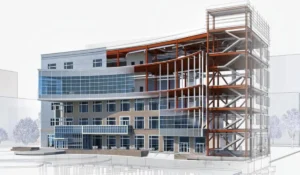
The fix has to happen at the source. A millimeter-level point cloud captured on site returns the real coordinates of every visible surface and lets you overlay as-built against as-designed to see exactly where they diverge. Werdhölzli started there: scan the plant while it was running, then model piping, tanks and structures from the measurement instead of from the existing documentation. If you want the distinction between a 3D model and a BIM model before going further, we cover it in 3D or BIM: differences and uses.
Sign 2: high LOD on geometry, zero LOI on information
This is the most expensive failure because it is the hardest one to see. A model can carry a high level of geometric development, with equipment modeled part by part, and not hold a single line of usable information: no manufacturer, no model number, no capacity, no install date, no vendor, no maintenance record. Geometry without information is a scale model.
The BIMForum LOD Specification exists precisely to set what content and what reliability you should expect from an element at each project stage. A digital twin consumes both dimensions: geometry to locate, information to decide. When you call up a work order on the model and the system cannot tell you which unit it is, the model is not incomplete. It is unusable for that purpose.
The practical test takes two minutes. Open the model, select the single most critical asset in your operation, and look at the parameters attached to it. If all you get is its category and its dimensions, you have a design model, not an operating baseline.
Sign 3: assets have no consistent naming or parameters
The same pump shows up as “Pump 3”, “PUMP-03” and “P-003” across three views of the same file. As long as a human is reading the model, that works. The moment you connect it to another system it stops working, because that system has no way of knowing the three names are one asset.
This is where ISO 19650-1, on information management using BIM, stops being paperwork and becomes a technical requirement. It defines how information is structured, named and delivered across the asset life cycle, which is what a twin needs in order to talk to your ERP or CMMS. On the manufacturing side, ISO 23247-1, the digital twin framework for manufacturing, starts from the same premise: the twin is built on observable, identifiable manufacturing elements, not on anonymous objects.
On projects where we build connectors so the digital twin can exchange data with systems like SAP or Maximo, naming is the first piece of work, not the last. Without stable identifiers there is no integration, just two databases looking at each other from across the room.
Sign 4: the model was never updated after the last retrofit
Check the file’s last modified date against the date of the last physical change on site. If an expansion, a line changeover, a new substation or a remodeled area happened after that date, the model is describing a plant that no longer exists.
This one compounds, because changes accumulate and nobody documents them individually. What starts as a discrepancy in one corner of the plant ends up as a model the operations team stopped opening, precisely because they learned they could not trust it. A digital twin built on that foundation does not inherit stale data. It inherits the distrust of the team that was supposed to use it.
It is also the cheapest failure to repair. It does not require remodeling the whole asset, only scanning and updating the areas that changed, which in most cases is a fraction of the total.
Sign 5: nobody owns keeping it alive
The first four signs are technical. This one is organizational, and it decides whether the project survives into year two. A digital twin is not a deliverable you receive and file away. It is an information asset that degrades the moment nobody updates it when the physical asset changes.
If there is no named person accountable for making the model reflect every change, and no procedure forcing an update before a minor job is closed out, the twin repeats the as-built story: born accurate, aged quietly. It is the failure we have watched surface most often after a technically flawless handover, and the lesson we took from it is that model governance gets defined before the first scan, not once a platform is already under contract. That is why we raise it in the first meeting, and why the model is delivered in native editable files with viewers for your team. It is yours, and that ownership carries the obligation to maintain it. That is the point where a vendor stops being a vendor and starts working as a strategic partner to the operation.
If you are still building the business case before assigning that person, digital twins in Industry 4.0 covers how it translates into operating results.
What a digital twin will not fix
A digital twin will not repair a badly designed process, and it does not replace the judgment of your maintenance team. It shows what is happening and lets you simulate scenarios; the call is still yours. It also does not require sensors everywhere on day one. You can start with a passive twin, aimed at asset inventory and documentation, and scale to an active twin with sensors as the operation matures.
And it is worth saying plainly: not every plant needs one. If your operation fits in two buildings, the crew has been there fifteen years, and changes are rare, a well-executed Scan to BIM with asset information may solve the problem without a platform on top. The digital twin earns its keep when you have asset volume, staff turnover, or a high cost per unplanned shutdown.
What the start looks like when the model does qualify
The process runs in four stages: on-site capture with high-precision laser scanners, conversion into a structured BIM model, enrichment with technical data such as manuals, warranties and maintenance dates, with IoT sensors where they are needed, and delivery through a secure web platform where your team views the twin in a browser, with no specialized software to install.
Among the results we report on our digital twin projects is downtime reduced by up to 30% through predictive maintenance, with a return typically seen in under 12 months from maintenance savings, fewer site visits and avoided line stoppages. Those numbers depend on the sector and on the starting point, and the starting point is the model.
Do not start by digitizing the entire plant at maximum detail. Start with the line or the area where a shutdown costs you measurable money, and validate the five signs there before you scale.
Frequently asked questions
What does a BIM model need in order to power a digital twin?
Three things: geometry verified against built reality, information attached to every relevant asset (manufacturer, model, capacity, maintenance), and consistent naming that lets another system identify each element. Without all three, the twin cannot integrate or simulate with confidence.
Can you build a digital twin of an older facility with no reliable drawings?
Yes, and that is where it delivers the most value. On existing assets, 3D laser scanning recovers the real geometry without depending on inherited documentation that is usually incomplete or out of date.
What is the difference between BIM and a digital twin?
A BIM model is a structured representation of the asset, with geometry and information. A digital twin is that representation connected to the operation: technical data, equipment status and, where required, real-time sensors, on a platform where you can view it and simulate against it.
How accurate is the 3D scanning that serves as the baseline?
Our terrestrial scanners are accurate to ±2 mm to 10 mm depending on the equipment and site conditions. That figure describes the capture instrument, and it is the baseline the model is built on afterward.
If you recognized two or more of the five signs in your current model, the problem is not the digital twin software you are evaluating. It is what you are about to feed it.
Tell us what model you have today and we will audit it: whether it can serve as the foundation for a digital twin, or exactly what it is missing, checked against your physical asset. The point is not to sell you more model. It is to give you certainty about the one you already have. Request your BIM model audit here.