Digital Boturini Codex: How INAH Is Revolutionizing Heritage Preservation with Digital Twins
Digital Boturini Codex: How INAH Is Revolutionizing Heritage Preservation with Digital Twins
When Millennia of History Meet Digital Innovation
Imagine being able to explore every stroke of the Boturini Codex —that valuable relic recounting the Mexica migration— from your screen, with no risk of damaging the original. That experience is already possible thanks to the digital edition of the Boturini Codex that INAH has made available to the public.
Although Foundtech has not collaborated directly on that project, we see in this initiative a key parallel with our own work: generating precise digital replicas that preserve and share cultural heritage, just as we create architectural digital twins.
What the Digital Edition of the Boturini Codex Is
The digital edition of the Boturini Codex (or Strip of the Pilgrimage) is an institutional effort by INAH that allows the codex to be explored through high-resolution images, digital facsimiles, and interactive tools that combine the visual with the documentary.
This project is part of a broader strategy for digitizing Mexican codices, which began with the publication of the Digital Mendoza Codex. In addition to the digital edition, a facsimile version was released, printed on amate paper using traditional techniques to respect the material legacy of the document.
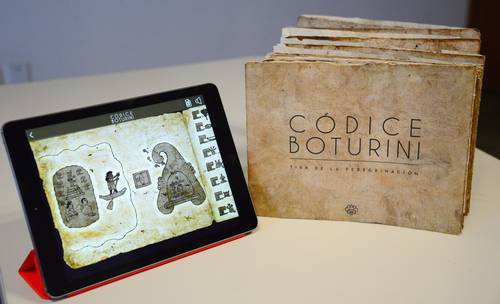
For example, the facsimile version is printed with organic pigments that guarantee a projected lifespan of up to 200 years, and the digital application allows for a deeper interaction with the details of the codex.*
The digital version is complemented by contextual content (texts, interpretation, downloads), allowing mass access without putting the original document at risk.
Parallel with Architectural Digital Twins
Although the domain of the codex is documentary and symbolic, the technological processes used share important similarities with those we use in architectural modeling and the digitization of buildings.
Shared Processes
- High-precision capture
For the codex, photogrammetry, multispectral scanning, and surface modeling are used to capture details. In architecture, we use 3D laser scanning and point clouds. - Interactivity and exploration
The digital edition lets the user zoom, rotate, and read descriptions. In an architectural digital twin, the 3D model enables virtual walkthroughs, clash detection, and simulations. - Preservation and risk reduction
Through the digital edition, physical handling of the codex is minimized, preserving its integrity. In heritage buildings, the digital twin avoids invasive inspections and reduces physical wear. - Accessibility and dissemination
The digital document reaches global audiences. Likewise, architectural digital twins allow stakeholders, researchers, and communities to access the built heritage.
However, there is one essential difference: in architecture, dynamic layers can be added (such as IoT sensors and real-time data), whereas codices remain within the domain of the historical document.
Benefits and Limitations of the Digital Approach
Benefits
- Digital preservation and reduced physical risk
By not handling the document continuously, physical deterioration is reduced. - Mass access
Researchers, students, and the general public can explore the codex from anywhere. - Advanced analysis
The use of multispectral images reveals details invisible to the human eye. (Boturini) - Long-term conservation
Backups, replications, and distribution can be carried out without material wear.
Limitations
- Fidelity vs. material context
The digital experience does not replace the tactile perception or the real texture of the codex. - Implementation complexity
It requires technical expertise in capture, color calibration, editing programs, metadata, etc. - Initial cost
Specialized digitization (multispectral, facsimile) carries a high cost, though with medium-term benefits. - Technological dependence
It requires stable platforms, interoperable standards, and ongoing digital maintenance.
Implications for Foundtech and for Your Project
Although Foundtech did not take part in the digitization of the codex, this digital edition is a valuable reference for understanding how to apply similar methodologies to architectural heritage. We can draw lessons such as:
- Quality criteria in capture and calibration
- Metadata structure and open formats
- Multimedia dissemination strategies
- Integration of interpretive layers over the base model
If you are a researcher, cultural institution, or heritage professional and you are looking to digitize historic documents or buildings, we can accompany you from the base model to interactive versions.
You may also be interested in: Scan to BIM: The New Frontier in Architectural and Engineering Precision
Conclusion
The digital edition of the Boturini Codex demonstrates that it is possible to merge the ancient with the digital: transforming a documentary legacy into an interactive platform accessible to the world. Although INAH leads that effort, its digital methods are useful paradigms for those of us who work in architectural digitization.
At Foundtech we envision this convergence as an opportunity: we not only digitize physical structures, but we also help to preserve and share cultural heritage. If you have a heritage or architectural project that you want to bring into the digital world, we are ready to help you with technical precision and strategic vision.
👉 Discover our BIM digitization services
—————————————————————————————————————