Digital Twins in Mexican Hotels: Innovation and Operational Savings
Digital Twins in Mexican Hotels: Innovation and Operational Savings
Picture a hotel in Mexico whose building, HVAC systems, electrical installations and guest flow are replicated virtually in a dynamic way. A digital twin that anticipates failures, simulates scenarios and supports decisions in real time. Far from being science fiction, this vision is increasingly viable thanks to the convergence of the digital twin with BIM in Mexico.
At Foundtech we believe the Mexican hospitality industry has a unique opportunity: to adopt cutting-edge technologies that turn operations into a competitive advantage. In this article we will explore what a digital twin is in hospitality, how to integrate it with BIM, use cases in the sector and the tangible benefits a Mexican hotel can achieve by betting on this innovation.
What is a digital twin applied to hotels?
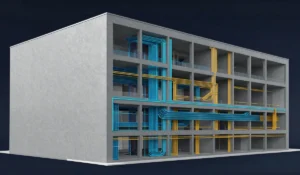
A hotel digital twin is an intelligent virtual replica of the physical building and its systems: HVAC, electricity, water, lighting, security, access control, etc. But it goes further: this model is continuously connected to IoT sensors and operational systems, making it possible to monitor real-world conditions and simulate usage scenarios.
Essential components:
-
Base BIM model: detailed 3D representation of the architecture and systems.
-
Active IoT sensors: temperature, humidity, foot traffic, energy consumption.
-
Synchronization platform: two-way updates between the physical and the digital.
-
Simulation and predictive alert engine: based on rules and historical data.
This allows the hotel not only to observe its operation, but also to forecast failures, optimize maintenance and plan expansions with ease.
In the article “How Digital Twins Transform Hospital Management” by Foundtech, the hotel digital twin is defined as a “virtual replica of the hotel that integrates real-time data to optimize operations.”
Why invest in digital twins in the Mexican hospitality industry
1. Operational efficiency and cost reduction
By monitoring critical systems with real-time data, it becomes possible to:
-
Detect energy anomalies (HVAC overuse, lighting left on unnecessarily)
-
Schedule preventive maintenance precisely when it is needed
-
Simulate scenarios before making physical changes (floor reconfiguration, expansion)
This reduces energy spending and corrective maintenance, significant components of a hotel’s OPEX.
2. Improving the guest experience
Thanks to the digital twin, uncomfortable conditions can be anticipated —for example, elevated temperature in rooms— and adjusted before a guest notices. In addition, simulations make it possible to optimize internal routes, transfer times and internal logistics within the hotel.
3. Scalability and sustainability
A hotel with a well-designed digital twin can grow or adapt with additional modules (new wings, amenities). It also supports green certifications, since it makes it possible to monitor and reduce consumption and emissions, aligning operations with sustainability goals.
4. Competitive advantage and technological branding
Being one of the first Mexican hotels to operate with a digital twin can be part of the value proposition against international groups. You can promote efficiency, comfort and technology as differentiating attributes.
How to implement it: recommended steps for Mexican hotels
-
3D survey + initial BIM modeling
Use a 3D laser scanner to capture the existing building and create the base model in BIM. -
Sensor selection and installation
Environmental sensors, energy meters, cameras for foot traffic, occupancy systems. -
Integration and synchronization platform
Connect BIM with the IoT data layer and the hotel’s operational systems (BMS, RMS, ERP). -
Simulation and go-live
Create scenarios (seasonal, peak occupancy, system failure) to validate and calibrate the digital twin. -
Continuous monitoring and optimization
Adjustments to control rules, Machine Learning for predictive alerts and iterative improvements.
Use cases and global examples
-
In the hospitality industry, gains in operational efficiency and cost reductions have already been observed when using digital twins and advanced simulation (Simio).
-
In Latin America, BIM & Digital Twins are positioned as strategic technologies in urban projects and smart buildings (redciudad.org).
-
In Mexico, Plan BIM México drives the adoption of BIM standards as a basis for interoperability and sophisticated models in the operation of public and private assets (Global BIM Network –).
Critical points to consider
-
Quality of the initial data: A digital twin is only as good as the BIM foundation and the accuracy of the scan.
-
Security and privacy: Hotel operations involve sensitive data (foot traffic, access), so cybersecurity is key.
-
Investment cost vs. return: ROI and the payback horizon must be studied (3-5 years is typical).
-
Training and organizational culture: Staff must adapt and consult the digital twin as a routine tool.
Conclusion: Smarter, more efficient and more sustainable hotels with Digital Twins
The integration of digital twins and BIM in Mexican hotels is not a passing trend: it is a necessary evolution in the face of an increasingly competitive, demanding and efficiency-oriented sector. This combination of technologies enables hotels to operate with a 360° view of their facilities, make decisions based on real-time data and get ahead of problems before they occur.
In a country with a tourism ecosystem as diverse as Mexico’s, where efficient operations and the guest experience are key differentiators, having a digital twin can mean the difference between being just one more option and leading the future of hospitality.
At Foundtech, we work with hotels, real estate groups and architecture firms to design, implement and operate custom-built digital twins. From the initial 3D scan to continuous operational optimization, we are strategic partners in transforming physical spaces into intelligent infrastructure.