Mid-Year Scheduled Shutdowns: How to Reduce Downtime With Digital Twins
Every minute your plant remains stopped during a scheduled shutdown represents thousands of pesos in lost production. And the most frustrating part is that many of those minutes are wasted on unforeseen events that could have been anticipated: a part that does not fit as expected, a procedure that takes twice the estimated time, or a bottleneck that no one detected during planning.
The difference between an efficient maintenance shutdown and an operational headache lies not only in logistics, but in the ability to simulate, test and optimize every intervention before touching a single valve or stopping a line. This is where industrial digital twin technology is transforming the way plants in the metallurgical, mining, energy and manufacturing sectors approach their scheduled maintenance.
At Foundtech we have documented how companies have reduced their downtime by up to 40% by implementing virtual replicas of their critical processes. In this article we show you exactly how this technology works, what concrete benefits it brings to your operation and how you can start applying it in your next maintenance shutdown.
What an industrial digital twin is and why it matters for maintenance
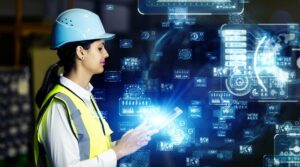
A digital twin is an exact virtual replica of a physical asset—a plant, a production line, an entire MEP system—that updates in real time through IoT sensors and makes it possible to simulate scenarios without interrupting the real operation.
Unlike a static 3D model (like those generated by the Scan to BIM process), the digital twin is dynamic: it reflects the current operational state, integrates historical maintenance data and makes it possible to run predictive simulations.
Key components of a digital twin for maintenance
| Component | Function | Direct benefit |
| As-Built 3D model | Precise geometry captured by laser scanner | Spatial planning without dimensional errors |
| IoT sensors | Real-time data (temperature, vibration, pressure) | Early detection of anomalies |
| Simulation engine | Testing of “what if…” scenarios | Optimization of work sequences |
| CMMS integration | Maintenance history and work orders | Decisions based on real patterns |
| Executive dashboard | KPIs visualized in real time | Agile decision-making during the shutdown |
In the Mexican context, where sectors such as mining, petrochemicals and automotive manufacturing run plants 24/7, the difference between a 48-hour shutdown and a 72-hour one can mean millions of pesos in deferred production.
Why the digital twin outperforms the traditional approach
Traditional methodology:
- Outdated PDF drawings.
- Prior physical inspections that halt production.
- Time estimates based on experience, not data.
- Discovery of clashes during execution.
Methodology with a digital twin:
- 3D model synchronized with the real state of the plant.
- Virtual simulations of each intervention.
- Times calculated with millimeter precision.
- Detection of clashes before mobilizing equipment.
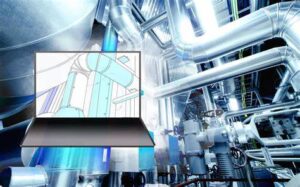
The As-Built 3D models capture the exact geometry of your facility and are the fundamental basis for building a reliable digital twin.
Simulating maintenance shutdowns: from planning to the virtual twin
The key to success in a scheduled shutdown lies in the prior simulation phase. This is where the digital twin proves its real value.
Step-by-step simulation process
- Capturing the current reality
- 3D laser scanning of critical areas (±2 mm precision).
- Integration of data from installed IoT sensors.
- Updating the model with recent undocumented modifications.
- Modeling the intervention
- Importing new or replacement equipment into the twin.
- Simulating disassembly and assembly sequences.
- Validating access, clearances and crane routes.
- Clash analysis
- Automatic detection of physical collisions.
- Identification of space restrictions for tools.
- Verification of electrical and thermal isolation requirements.
- Time optimization
- Critical-path calculation with real duration data.
- Identification of viable parallel tasks.
- Simulation of contingency scenarios.
Impact on sustainability
Shorter, more efficient shutdowns have a direct effect on the environmental footprint:
- Lower energy consumption during startups and shutdowns of main equipment.
- Reduction of waste due to fewer execution errors.
- Logistics optimization (fewer supplier trips).
- Compliance with NOM-035-STPS-2018 by reducing extended shifts for personnel.
In regulated sectors such as energy, this traceability is essential for sustainability audits and ESG reports.
Operational resilience
The digital twin acts as living institutional memory:
- Automatic documentation of every modification.
- Knowledge transfer between maintenance shifts.
- Database of lessons learned linked to the 3D model.
- Training of new personnel in a safe virtual environment.
The application of the digital twin in hospitals shows how these same principles protect critical infrastructure where downtime can put lives at risk.
Integration with Industry 4.0: beyond maintenance
Your plant’s digital twin is not just a tool for scheduled shutdowns: it is the backbone of a comprehensive Industry 4.0 strategy.
Complementary use cases
- Continuous energy optimization
- Simulation of load scenarios to identify inefficiencies.
- Modeling of thermal insulation improvements.
- ROI calculation of equipment upgrades.
- Immersive training
- Training of operators in emergency procedures.
- Certification of contractors in a virtual environment.
- Risk reduction in onboarding new personnel.
- Expansion planning
- Simulation of new production lines.
- Analysis of impact on existing services (HVAC, electrical).
- Validation of regulatory compliance (NOM-001-SEDE, ISO 50001).
- Asset management
- Traceability of every critical component.
- Prediction of service life based on real conditions.
- Optimization of spare-parts inventory.
Interoperability with existing systems
The digital twin does not replace your current systems: it enhances them.
Common integrations:
- ERP (SAP, Oracle): synchronization of work orders and costs.
- CMMS (Maximo, Infor): maintenance history linked to the 3D model.
- SCADA/DCS: real-time operational data.
- Safety systems: alarms and response protocols integrated into the 3D model.
Turn your next scheduled shutdown into a competitive advantage
Maintenance shutdowns are no longer a necessary evil: with a digital twin they become a control point where the operation gains efficiency, data and certainty. The question is no longer whether it is worth implementing, but how much it costs not to do it in the next window.
At Foundtech we combine 3D laser scanning with millimeter precision, BIM modeling under the ISO 19650 standard and operational digital twins so that your next shutdown is executed in less time, with less risk and with a reusable digital record. If you are planning a major intervention more than 6 months out, now is the time to scan, model and simulate. Contact us / schedule a free assessment.