How to Prepare Your Hotel for Major Events, With Digital Twins
Preparing your hotel for events like the 2026 World Cup with a digital twin is essential in host cities. It can be done in less time or more nimbly when you document the as-built reality with 3D laser scanning, connect critical systems to a living As-Built BIM model and define clear rules for monitoring, alerts and coordination between departments before the first international guest arrives. Without that preparation, the 100% occupancy that major events promise (for example, this year’s 2026 World Cup) turns into six weeks of HVAC failures, online complaints and a reputation that takes years to rebuild.
Why a hotel without a digital twin arrives vulnerable
Take, for example, hotels in Mexico City, Guadalajara and Monterrey: the 2026 World Cup will be the biggest operational stress test of the last decade. It is the first World Cup with 48 teams: more matches, more international fans and consecutive weeks at 100% occupancy. The property that arrives with poorly documented systems—outdated drawings, reactive maintenance, no cross-visibility between housekeeping, engineering and front desk—does not face an abstract risk: it faces the certainty that something could fail at the worst moment.
The problem is not a lack of technology. Most hotels already have a CRM, a building management system (BMS), maintenance software and CAD drawings. The problem is that this information lives in silos: the general manager does not see what engineering sees, engineering does not see what housekeeping sees, and no one operates against a verified 3D model of the real building.
This is where the hotel digital twin stops being a technology experiment and becomes critical operational infrastructure, with measurable benefits for general managers, maintenance managers and owners:
- They turn drawings into living information: the As-Built model verified with 3D laser scanning documents the building as it is today, not as it was designed in 2008. Sensors, work orders and occupancy data are layered on top of that.
- They reduce the risk of critical failures during peak occupancy: with continuous monitoring, the system detects unusual vibrations in compressors, gradual pressure drops and anomalous consumption patterns before the guest reports the problem.
- They protect online reputation when each review carries more weight: during the World Cup, a 4-hour air-conditioning failure in a full hotel translates into dozens of simultaneous negative reviews on international platforms.
- They allow you to anticipate demand instead of reacting: the digital twin cross-references projected occupancy, weather forecasts and historical patterns to pre-cool zones, stagger consumption and assign staff before the bottleneck.
- They create a digital asset that outlives the event: the verified model and historical data keep serving the property long after the World Cup: refinancing, expansions, sustainability certifications and due diligence for a sale.
The industry data is compelling. A well-implemented digital twin can reduce maintenance rework by up to 35%, cut incident response times by 25% and improve operational efficiency by 22% in the operation phase.
For hotels in host cities, arriving at the 2026 World Cup without an operational digital twin is not a saving: it is betting a reputation built over years on six weeks with no margin for error. The right question is not “do I need a digital twin?”, but “with what level of detail, which connected systems and in how much time am I going to have it running?”.
To understand how 3D laser scanning becomes the operational foundation of a hotel digital twin, review: BIM and As-Built Modeling.
What a hotel digital twin is and what it is made of
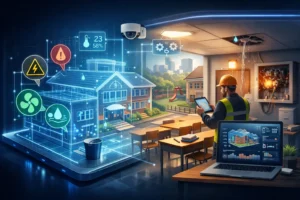
A digital twin is a dynamic, three-dimensional virtual representation of your property that continuously updates with real-time data. In the hotel context, it means having an exact digital replica of the building that reflects the operational status of every system, from the air conditioning in room 501 to the boilers in the basement.
Unlike traditional drawings or even static BIM models, a digital twin is alive: it is fed by temperature sensors, energy consumption meters, work order records and automation systems. This integration makes it possible to visualize not only where each asset is, but also how it is performing at this very moment.
For a digital twin to work effectively in your hotel, it requires three fundamental pillars:
- Precise As-Built 3D model: captured through 3D laser scanning (LiDAR technology), it documents with millimeter precision every detail of the building as it was built, not as it appears in outdated drawings. It is the foundation on which all the other information layers are mounted. On this capability, review: Scan to BIM.
- IoT and BMS data integration: sensors distributed throughout the property feed the model with real-time information on temperature, humidity, energy consumption, water pressure and equipment status.
- Centralized management platform: software that consolidates all this information into intuitive dashboards, generates predictive alerts and facilitates coordination between maintenance, operations and management teams.
Order matters: without a verified As-Built model, the sensor and dashboard layers float over imprecise drawings. The reality of the building is the foundation of the digital twin; the rest is instrumentation on top of that base.
How predictive maintenance works with digital twins
Your digital twin continuously monitors the performance of the hotel’s critical systems:
- HVAC systems: detects anomalous consumption patterns, variations in outlet temperature and unusual vibrations in compressors that indicate imminent wear.
- Hydraulic systems: identifies gradual pressure drops that suggest hidden leaks, or sediment buildup in pipes that will end in blockages.
- Elevators: analyzes response times, electrical consumption and usage patterns to schedule maintenance during low-occupancy windows.
- Electrical systems: monitors loads by circuit, detects overheating in panels and prevents failures at critical moments.
To dive deeper into how we document the real state of a built asset before digitizing it, review: As-Built Drawings.
Energy optimization: every kWh counts when occupancy does not drop
Energy management is one of the biggest operational challenges in hotels: it typically represents between 4% and 6% of total revenue. During peak-occupancy periods like the 2026 World Cup, that percentage grows if there are no intelligent optimization systems that adjust consumption to real demand.
Digital twins transform energy management from reactive to proactive: they make it possible to identify hidden inefficiencies, simulate optimization scenarios and execute savings strategies without compromising the guest experience.
Identifying hidden inefficiencies
Your digital twin creates a complete thermal map of the property, revealing:
- Zones with thermal losses: areas where insulation deficiencies or air infiltration cause significant energy waste.
- Underperforming equipment: systems that consume more energy than expected for their operational load, indicating a need for maintenance or replacement.
- Inefficient usage patterns: spaces that are conditioned unnecessarily during periods of low or no occupancy.
- Cogeneration opportunities: identification of reusable waste heat for heating water or spaces.
Data-based optimization strategies
With precise information about the energy behavior of each zone, strategies that were previously operationally unviable become feasible:
- Dynamic HVAC zoning: instead of conditioning entire floors uniformly, the digital twin adjusts temperature room by room according to real occupancy. During the World Cup, with constant check-ins and check-outs, it means conditioning only the rooms that are occupied or about to be occupied.
- Intelligent pre-cooling: the system analyzes occupancy patterns, weather forecasts and hourly electricity rates to pre-cool spaces during lower-cost energy periods, reducing the load during peak hours.
- Peak demand management: by visualizing the real-time consumption of all systems, you can stagger loads to avoid demand peaks that generate penalties on your electricity bill.
- Adaptive lighting: integration with smart lighting systems that adjust intensity according to available natural light and real occupancy of spaces.
To learn how we connect the digital twin to the real operation of the building, review: Digital Twin.
Real-time operational coordination: the end of logistical chaos
One of the most underestimated aspects of the digital twin in hospitality is its ability to transform operational coordination. During high-demand events, synchronization between housekeeping, maintenance, front desk, food and beverage, and security becomes exponentially more complex.
A digital twin works as the hotel’s central nervous system: all departments view the same operational status in real time and coordinate actions without friction.
Shared visibility: the end of silos
Traditionally, each department operates with its own fragmented information:
- Housekeeping: knows which rooms are clean or require service.
- Maintenance: has its work orders in a separate system.
- Front desk: knows scheduled check-ins and check-outs.
- Engineering: monitors mechanical systems without occupancy context.
This fragmentation generates costly inefficiencies: clean rooms that cannot be sold because maintenance did not finish a minor repair, technicians who interrupt guests because they did not know the room was occupied, or cleaning teams waiting while a plumbing problem is resolved.
With a digital twin, all departments view the same dashboard updated in real time:
- Status of each room: occupied, vacant, clean or under maintenance, located in the 3D model of the floor.
- Maintenance orders: open, in progress and closed, with an assigned owner and exact location in the model.
- Predictive alerts: about critical equipment before the guest reports the problem.
- Housekeeping staff position and ETA: to synchronize with check-in and check-out.
- Energy consumption metrics by zone: contrasted against real occupancy and historical patterns.
Coordination during the event: hypothetical examples from the 2026 World Cup
During the six weeks of the 2026 World Cup, this shared visibility stops being a convenience and becomes operationally critical. Some examples of the kind of decisions the digital twin accelerates:
- Handling a leak on the 8th floor: without opening cross-tickets between three systems: maintenance sees the exact location in the model, housekeeping receives an automatic alert to reassign cleaning and the front desk avoids assigning new check-ins to rooms downstream.
- Reassigning cleaning by proximity to the next pending check-in: instead of following the theoretical floor order. At 100% occupancy, saving 10 minutes per room translates into rooms available sooner and guests who do not wait in the lobby.
- Activating peak-demand protocols: when the dashboard predicts an HVAC bottleneck before the temperature rises on the executive floor. Pre-cooling, load staggering and zoning adjustment are executed before the guest feels the problem.
- Coordinating the return of fans after matches: anticipating hot-water consumption in showers, elevator demand and room-service peaks within a 90-minute window.
The tangible result: shorter response times, fewer interrupted touchpoints for the guest and an operational team that enters the event with a single source of truth, not with four systems that contradict each other.
Conclusion: the 2026 World Cup is the stress test you cannot improvise
Preparing your hotel for major events or high-occupancy dates, with a digital twin, is not a cosmetic improvement: it is the technical decision that separates the properties that capitalize on six weeks of record occupancy from those that survive amid operational crises. An As-Built model verified with 3D laser scanning, connected to IoT sensors and shared across the entire operation, transforms reactive decisions into measurable operational certainty.
For general managers, operations managers and owners who want to reduce maintenance rework by 35%, cut response times by 25% and improve operational efficiency by 22% during the highest-demand hotel event of the decade, the first step is not buying technology: it is capturing the reality of the building before the first reservation arrives. At Foundtech we support clients in Europe and the Americas with modeling under ISO 19650 certification, combining 3D laser scanning, As-Built BIM modeling and digital twins so that your digital investment translates into certainty, efficiency and building the future.
Foundtech does not operate your hotel during major events, but it does deliver the digital twin your team needs to run it without crises.
Ready for your team to have total visibility of the hotel and every system? Request your FREE property assessment here.