Impact of Industry 4.0 on productivity: cases and strategies
The impact of Industry 4.0 on productivity shows up in automation, real-time monitoring, and data analysis that cut downtime and operating costs. This article covers what Industry 4.0 is, its main contributions to productivity, three industry 4.0 case studies, and how Foundtech implements continuous monitoring as part of the same transformation.
Industry 4.0, or the Fourth Industrial Revolution, is transforming the way companies operate, elevating productivity to unprecedented levels. Through the integration of advanced technologies, this transformation is redefining processes and strategies across various sectors. Next, we explore the impact of Industry 4.0 on productivity and analyze some key cases and strategies.
What is Industry 4.0?
Industry 4.0, also known as the Fourth Industrial Revolution, represents a new era in production and business management, characterized by the integration of advanced technologies into industrial processes. This revolution is based on the digital connection of machines, systems, and processes through the Internet of Things (IoT), automation, artificial intelligence (AI), and the analysis of large volumes of data, known as Big Data.
Industry 4.0 transforms the way products are designed, manufactured, and managed, enabling greater efficiency, customization, and flexibility in production while promoting more sustainable practices and contributing to a significant improvement in overall productivity.
Increase in efficiency
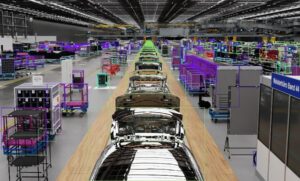
One of the main contributions of Industry 4.0 is the increase in efficiency. Automation and robotics have been fundamental in this regard. Automated systems and robots perform repetitive and hazardous tasks with superior precision and speed, reducing production times and operational costs.
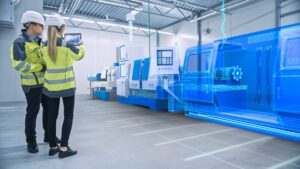
Big Data and artificial intelligence (AI) also play a crucial role. The ability to collect and analyze large volumes of data in real time enables companies to identify inefficiencies and optimize processes, while the Internet of Things (IoT) facilitates the interconnection of devices and sensors in production plants, enabling quick detection of issues and minimizing downtime.
Customization and flexibility
Industry 4.0 has also impacted companies’ ability to offer customized and flexible products. Digital technologies enable rapid adaptation to market demands, resulting in increased customer satisfaction.
Small-scale production and product customization have become feasible thanks to these technological innovations, something that would have been economically unviable for most manufacturing plants just a decade ago.
Sustainability
Sustainability is another area benefited by Industry 4.0. Technologies such as AI help detect defects on production lines, which reduces waste and improves energy efficiency.
These advancements not only contribute to a smaller environmental footprint but also promote more responsible and sustainable practices in the industry, a criterion that matters increasingly to both customers and regulators.
Economic impact
The economic impact of Industry 4.0 is substantial. In 2022, it was estimated that this revolution generated an economic movement of around $131 billion, with projections for continued growth.
Companies that adopt these technologies not only enhance their productivity but also gain a more competitive position in the global market against competitors still running manual or poorly integrated processes.
How Foundtech applies this: continuous plant monitoring
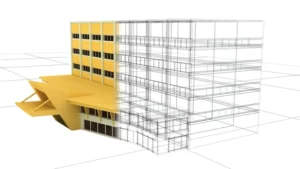
One of the Industry 4.0 pillars mentioned above, real-time monitoring through IoT, is exactly what Foundtech implemented at the Werdhölzli wastewater treatment plant in Switzerland. The team generated a complete digital twin of the existing infrastructure using 3D laser scanning, a reliable data foundation on which the plant’s redesign was planned instead of working from outdated documentation. See the full Werdhölzli case.
This same principle, having an accurate digital model of the real condition of the assets, is the foundation of a good predictive maintenance system, another direct application of Industry 4.0 in industrial plants.
Success stories and key strategies
Notable success stories include:
- Hega Hogar: digitized its production processes and improved planning, resulting in a significant increase in productivity.
- Aceites Maeva: used real-time data-based incentive systems to improve production performance.
- Eckermann: improved traceability and quality of its processes through the integration of advanced technologies.
Key strategies to enhance productivity include:
- Automation and robotics: improves precision and speed in production, reducing costs and time.
- Real-time monitoring: enables early detection of issues and continuous process optimization.
- Data analysis and AI: facilitates the identification of inefficiencies and informed decision-making.
- Flexibility and customization: adapts production to changing market demands, increasing customer satisfaction.
| Industry 4.0 pillar | Enabling technology | Effect on productivity |
|---|---|---|
| Efficiency | Automation and robotics | Less production time and operating costs |
| Failure prevention | IoT and real-time monitoring | Less unplanned downtime |
| Decision-making | Big Data and AI | Early identification of inefficiencies |
| Customization | Flexible manufacturing | Higher customer satisfaction |
Frequently asked questions about the impact of Industry 4.0
How much does Industry 4.0 improve productivity?
The impact varies by technology and sector, but it concentrates on three fronts: less downtime through predictive monitoring, lower operating costs through automation, and better decisions through real-time data analysis. The global economic impact has been estimated at more than $130 billion.
Where should a company start when adopting Industry 4.0?
Most successful projects start with a reliable data foundation on the real condition of the assets, typically through a digital survey or 3D scan, before adding sensors or automation. Without that accurate starting point, the rest of the technologies have less to work with.
What technologies make up Industry 4.0?
Its main pillars are the Internet of Things (IoT), automation and robotics, artificial intelligence, Big Data analysis, and digital twins, which integrate these technologies into a virtual representation of the physical asset.
You might be interested in: Digital Twins: The Key to Unlocking the Potential of Industry 4.0
In summary, Industry 4.0 is redefining business productivity through the integration of advanced technologies that enhance efficiency, enable greater customization, promote sustainability, and create a positive economic impact. Companies that adapt to these innovations, starting with a reliable data foundation for their own assets, will be better prepared to face future challenges.