Shopping Malls and Net Zero 2030: Why a Digital Inventory Is the 1st Step Toward Decarbonization
A Digital Inventory is the first step toward Net Zero 2030 in shopping malls because it turns an opaque building into a measurable asset: only when you know precisely what has been built, how it behaves and where it consumes energy can you design a realistic, financeable and verifiable decarbonization strategy.
How a digital inventory drives Net Zero in shopping malls
For a shopping mall to reach Net Zero 2030 targets, it needs much more than solar panels or efficient equipment: it requires a digital as-built inventory, based on Scan-to-BIM and Digital Twins, that integrates real geometry, MEP systems, consumption and operating conditions into a single data platform. This foundation makes it possible to calculate energy baselines with precision, simulate efficiency measures (HVAC, envelope, lighting), prioritize investments by ROI and document results for ESG certifications, something already being done in complex assets such as hospitals and malls through solutions very similar to those offered by Foundtech.
Why Net Zero commitments fail without a digital inventory
The transition toward Net Zero in retail demands robust metrics, traceability and data-driven decisions; however, many shopping malls do not know exactly what their real configuration is after years of remodels, tenant changes and expansions. That gap between the building “on paper” and the “real” building means any energy audit, investment plan or ESG certification starts from incomplete assumptions.
A property without a digital inventory suffers from:
- Imprecise energy audits, because areas, volumes and systems do not reflect the current reality.
- Poorly prioritized investments, by over- or under-sizing HVAC and lighting without reliable thermal zoning.
- Longer and more costly certification processes, due to the lack of centralized As-Built documentation.
The BIM and Digital Twin trends for 2026 already point to shopping malls and hospitals as sectors where this gap is being closed, precisely through comprehensive digitalization of the built inventory.
To understand how these models are applied to other complex assets, you can review:
- BIM, Digital Twins, and AI: The Construction Revolutionfoundtech
- 7 Digital Twin and BIM Trends That Will Transform Constructionfoundtech
What a Digital As-Built Inventory is and why it is key for ESG
A Digital As-Built Inventory combines As-Built 3D models, BIM and operational data into a rich representation of the building: from geometry to systems, materials and equipment with their relevant properties. In shopping malls, this inventory includes:
- Geometry and areas verified through 3D scanning and As-Built models.
- MEP systems (HVAC, lighting, power, plumbing) with location, capacity and condition.
- Envelope material properties (U-values, reflectance, etc.) for thermal analysis.
- Equipment metadata (brand, model, year, efficiency, expected service life).
In Foundtech’s approach, these inventories are built by combining Scan-to-BIM and As-Built 3D models, which can then be connected to sustainability analytics and Digital Twins.
Two foundational reads for this information layer:
- Scan to BIM: Transforming 3D Scanning into Actionable Datafoundtech
- 3D As-Built Models: What Benefits Do They Offer in Building Management?foundtech
How Scan-to-BIM turns the shopping mall into actionable data
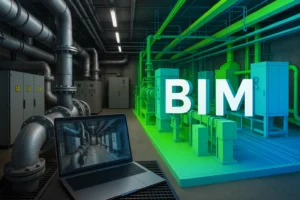
The Scan-to-BIM process captures the real building with a laser scanner and turns it into an intelligent BIM model ready for energy analysis, retrofit planning and ESG tracking.
Typical steps in a shopping mall:
- 3D laser scanning
High-detail point clouds are generated that reflect the real geometry of public areas, retail units, machine rooms, parking lots and roofs. - As-Built BIM modeling
The point cloud is translated into BIM elements (walls, slabs, facades, MEP equipment) with their real dimensions and spatial relationships. - Information enrichment
Each element can be tagged with material data, efficiencies, catalog data and energy parameters, creating a solid foundation for simulation and certifications.
This digitalization is the bridge between an opaque building and a measurable asset, and it is precisely the type of workflow that Foundtech describes in its content on Scan-to-BIM and As-Built models for building management.
Digital Twin: the living platform for continuous decarbonization
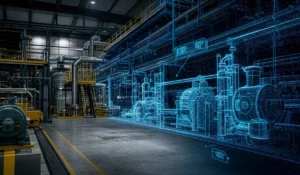
While the As-Built BIM offers a detailed snapshot of the building, the Digital Twin turns it into a living platform that integrates operational data, sensors, BMS and maintenance systems. In the Net Zero context, a Digital Twin of a shopping mall makes it possible to:
- Monitor energy consumption and environmental conditions by zone in (near) real time.
- Run simulations of efficiency measures (HVAC, lighting, envelope) based on real data.
- Plan and prioritize investments according to their impact on emissions and ROI.
Studies on Digital Twins in nearly zero-energy buildings (NZEB) show their usefulness in efficiently managing operation and maintaining projected energy performance. Foundtech brings this approach to complex infrastructure, such as hospitals and malls, with Digital Twins that integrate BIM, IoT and analytics.
A relevant sector example: Digital Twin in Hospitalsfoundtech
Conclusion: Net Zero 2030 starts with knowing what you have, not with buying technology
For a shopping mall to reach Net Zero 2030, the first step is not installing photovoltaic panels or signing green energy contracts, but building a solid Digital As-Built Inventory that makes it possible to measure, simulate and prioritize every decarbonization action. Without that foundation, audits are approximations, investments are made blindly and ESG certifications become slower and more expensive.
By combining Scan-to-BIM, As-Built 3D models and Digital Twins, companies such as Foundtech help shopping mall operators turn square meters into reliable, actionable data, which can then feed energy efficiency, predictive maintenance and renewable energy strategies with a life-cycle vision. In a scenario where climate commitments are increasingly demanding and pressure from investors and regulators is rising, having a precise digital inventory ceases to be a technological luxury and becomes the essential enabler of any Net Zero roadmap.