AR and VR with digital twins: the hotel virtual tour that actually fills December
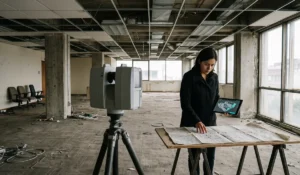
An AR and VR virtual tour converts bookings when it stops being a video of the hotel and becomes a measured copy of the hotel: the building is captured with a 3D laser scanner, that capture is published as a navigable tour on the hotel’s own site —and walked through with a VR headset in one-to-one sales—, and the same geometry stays available as a digital twin to show an event space already set up in augmented reality and to run the property for the rest of the year. One capture, three uses.
The urgency is a matter of calendar, not technology. Mexico’s Ministry of Tourism estimated 4.96 million guests in hotel rooms between December 20, 2025 and January 11, 2026, 5.3% more than the previous year, with Cancún, Los Cabos, Puerto Vallarta and Riviera Maya above 80% occupancy. That demand is booked months in advance, and a hotel that is full in December cannot be scanned in December.
By the end of this article you will know what each technology actually does (AR, VR and digital twin), which one sells rooms and which one sells event space, and when the property has to be captured to reach the year-end campaign with the asset live.
A December room is not sold in December. It is sold in September, when a family compares three hotels in the same browser tab; in October, when a corporate coordinator plans the 180-guest company holiday party and asks for photos of the ballroom; during El Buen Fin, Mexico’s national discount week in November, when the decision was already made and only the rate was left to settle. By then, what the hotel can show of itself is already fixed. If those are last year’s catalog photos, the conversation moves to the one ground where every hotel looks the same: price.
That is the problem an immersive tour solves, and it does not solve it by being prettier. It solves it by being verifiable. At Foundtech we do not produce hotel content: we capture the reality of the building with millimeter precision, and everything else comes out of that capture. It is the same method behind more than 200 projects across Europe and the Americas and 10 million m² modeled under ISO 19650 certification, alongside our European sister company BIM Facility. That is why a scanned hotel tour does not age the way a campaign does: it is a survey, and it serves equally to sell a suite and to plan the renovation of the south wing.
The December booking is decided in August
The window to produce immersive assets is now, between the end of the summer high season and the start of year-end advance sales. The reason is operational before it is commercial: a 3D scan works best with the hotel half empty. It needs available rooms, ballrooms without setup and common areas with little foot traffic; during a December holiday weekend, none of the three exist. Scanning in low season is not a scheduling preference, it is what makes the tour come out clean and free of people.
And the year-end demand is real. Press release 267/2025 from Mexico’s Ministry of Tourism estimated 4.96 million guests between December 20 and January 11, with 56.6% national occupancy and the major beach destinations above 80%. That 56.6% average is the uncomfortable figure: the country fills unevenly, and the difference between a hotel running at 80% and one running at 50% in the same destination is rarely the product. It is what each one managed to prove before the guest started comparing.
AR, VR and digital twin: three different things from a single capture
They are not synonyms and they do not sell the same thing. Virtual reality (VR) puts the person inside the space: the real hotel is walked through from a browser or a headset, and what it sells is the room. Augmented reality (AR) does the opposite: it overlays digital information onto the physical space, and what it sells is what does not exist yet —a ballroom set up for an event, a renovated suite, a terrace with a different layout—. The digital twin is the layer underneath: the living model of the building that supports the other two and keeps working after the campaign ends.
Autodesk defines it as a virtual representation of a physical object, system or environment that evolves with the flow of information from sensors, building information models and IoT objects. The word that matters there is evolves: a render is finished, a digital twin is updated. We have written before about how AR, VR and digital twins converge; what changes in hospitality is who pays for each layer. Marketing pays for VR because it fills rooms. Group sales pays for AR because it closes events. Operations pays for the digital twin because it avoids opening a wall to find out what is behind it.
The division of labor is specific. What we deliver is the measured capture and the navigable 3D virtual tour —accessible from a browser on mobile, tablet or desktop, VR-headset compatible and embeddable on the hotel’s site with an embed code—, plus the digital twin if the hotel wants the operational layer. The augmented reality experience is built on top of that geometry: it is not a product we sell separately, it is something the capture enables. Without measured geometry an AR layer floats; with it, it anchors to the centimeter.
What changes when the guest walks into the room before booking
What changes is that the person stops imagining the hotel and starts remembering it. A study published in Tourism Management (Bogicevic and colleagues, 2019) compared three ways of presenting a destination: photographs, a 360° tour and virtual reality. The VR preview produced greater elaboration of mental imagery and a stronger sense of presence than the other two, and that increase in presence translated into a more intense brand experience before setting foot in the place. In hotel operations terms: someone who has already seen themselves inside the room walks into the rate conversation holding a different yardstick.
One practical decision follows from that, and many hotels skip it. The tour embedded on the site works for mass traffic and for reducing dependence on third-party platforms —we covered that in 3D virtual tours and hotel marketing in Mexico—. The headset, on the other hand, is not for the anonymous visitor: it is for the seated sale, the corporate buyer deciding the Q1 convention or the agency putting together a room block. There, the VR tour replaces the site inspection nobody has time for anymore.
Selling the ballroom already set up: the other half of year-end revenue
Year-end is not only sold by the room: it is sold by the event. Company holiday parties —posadas, in Mexico—, New Year’s dinners, December weddings and conferences that close their budget before the fiscal year ends. And whoever buys a ballroom does not buy like a tourist. They do not ask whether the space is beautiful; they ask whether 180 people fit at round tables, where the columns are, what the floor-to-ceiling height is for the stage, and where the kitchen access runs.
Those are objections about measurements, and they are exactly the ones a scanned tour can answer without anyone traveling. The tour includes a built-in measurement tool, so the client checks the distance between columns rather than taking your word for it; and it supports hotspots with spec sheets, manuals or video anchored to a point in the space: room capacity per setup, available electrical load, loading dock access. That measured base is where an augmented reality layer earns its commercial keep: showing the coordinator the empty ballroom in front of her, already set up in the format she asked for, at real distances rather than in a render of some other hotel.
Once the event is signed, the same model changes hands and becomes an operations problem. We treat that separately in how to prepare your hotel for major events with digital twins: there the digital twin stops selling and starts coordinating maintenance, energy and equipment through the occupancy peak.
One survey, three returns
The argument that makes the investment viable is not the marketing one: it is that the cost is shared. The capture feeding this year’s year-end campaign is the same one that supports three different things afterwards. First, commercial: the tour on the site, in the group proposal and in headset-led sales. Second, operations: the digital twin of the property as the single source of truth for what sits behind each wall, without opening it. Third, capital projects: when renovation time comes, the Scan to BIM output of that survey is what keeps the architect from designing on drawings that no longer match the building.
That third return pays back fastest and is the one almost nobody counts when approving the marketing budget. On top of a faithful capture of the space we report up to 35% fewer reworks, 25% shorter execution times and 22% higher operational efficiency; for hotel renovation we break it down in how to reduce rework with BIM and in the BIM checklist for hotel renovation. A hotel that scans to sell December arrives at the March renovation with the survey already done and paid for.
What it takes to capture a hotel before the peak
The scan is non-intrusive and coexists with the hotel in operation: it is done zone by zone, with no construction, no service shutdowns and no rooms out of inventory beyond the time each capture takes. The process has four steps —3D scanning, generation of the immersive tour, integration with the model and the technical documentation, and delivery on an accessible platform— and the order matters: first define what you are going to sell, then what gets scanned.
The market overpromises here, so let’s mark the limit. An immersive tour is not a booking engine and does not replace your campaign: it does not sell on its own, it removes objections for whoever is already selling. It also does not replace the professional photography travel platforms require. If the campaign starts with El Buen Fin in November, the survey has to be done before October so the asset arrives published, tested on mobile and with the hotspots loaded. You can see the result in our projects.
Where to start this week
There is a short test for whether this is urgent or can wait another year. Open the hotel’s site and count how many ballroom photos show a real setup and how many are from an event five years ago. Then ask your group sales team how many quotes from the last quarter fell through because the client wanted to see the space and could not travel. If both answers are uncomfortable, the problem is not the rate: it is that the hotel does not let itself be seen.
And there is no need to capture the whole property up front. Start with what sells December —the main ballroom, the two highest-margin room categories and the event terrace— and let the model grow once it is already producing quotes. Tell us which spaces are in your year-end campaign and request the immersive virtual tour of your hotel here, while there is still availability on the calendar and rooms free to capture.
Quick questions
Do you need a VR headset for this to work?
No. The tour opens in a browser on mobile, tablet or desktop, which is how most of the traffic will see it. Headsets are compatible and pay off in one specific scenario: the one-to-one sale of groups, weddings and corporate events, where they replace the in-person site inspection.
When does the hotel have to be scanned to make the year-end campaign?
Before October. The capture needs available rooms and ballrooms without setup, conditions that disappear as the peak approaches; and after the scan there is still the tour to generate, the site integration and the hotspots to load. Scanning in low season is what makes it possible to publish before advance sales begin.